Manchild in the Promised Land
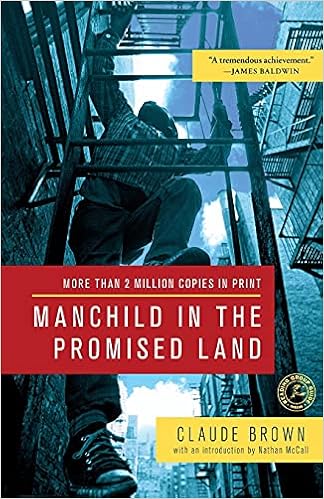
Published during a literary era marked by the ascendance of black writers such as Richard Wright, Ralph Ellison, James Baldwin, and Alex Haley, this thinly fictionalized account of Claude Brown’s childhood as a hardened, streetwise criminal trying to survive the toughest streets of Harlem has been heralded as the definitive account of everyday life for the first generation of African Americans raised in the Northern ghettos of the 1940s and 1950s.
When the book was first published in 1965, it was praised for its realistic portrayal of Harlem—the children, young people, hardworking parents; the hustlers, drug dealers, prostitutes, and numbers runners; the police; the violence, sex, and humor.
The book continues to resonate generations later, not only because of its fierce and dignified anger, not only because the struggles of urban youth are as deeply felt today as they were in Brown’s time, but also because of its inspiring message. Now with an introduction by Nathan McCall, here is the story about the one who “made it,” the boy who kept landing on his feet and grew up to become a man.
Reviews (149)

Powerful
I remember reading this when I was perhaps 10 or 12 years old. I don't think I really understood much of it, partly because I was a white, middle-class suburban kid trying to relate to Harlem, and partly because it had references to sex, drugs and crime that I just didn't get...didn't relate to at all. But it made a definite impact on me, to the point where I sought it out and re-read it...oh 40-45 years later. I still can't say I know Claude's world but I understand it more now than I did then.

Confabulated stream of consciousness
I know that this book has been in print a long time, and it has been suggested that it was a "classic." And so that prompted me to read it just so that I could say I had. After I finished it, I came away with several thoughts: 1. The events are just a little bit too unlikely. a. An eight-year-old gone from home for weeks at a time/hit by a bus / thrown into the river / hit by a car/ beaten with a chain? (p.12) b. Drinking as a 6 year old? (And remembering it?) 11 years of street life experienceat seventeen, and therefore starting from 6 years old? (p.161) c. A brother with the name "Pimp"? d. (p.31) Characters talking like what no-acting Halle Berry does in her slave movie-roles? ("Gettin' mannish with a little high yaller girl.") At, what, 9 years old? f. Being introduced to many books about people (by Mrs Cohen), even though just a few chapters earlier he said that he couldn't read. And given that he spent a total of 6 hours in school up until the age of 15 (p.156), how likely was that? g. (p 155, 100). Black guys that are not interested in white ladies? Or at least curious? it's also somewhat confusing, because he did have the relationship with Jewish Judy. And it was the best one in the book. h. He was able to play jazz piano after 6 months? Um, okay. 2. The recall ability is just a little bit too hard to believe. Brown wrote this book when he was about 27 years old, and he has all of this instant recall of just about EVERY SINGLE WORD from conversations that happened 17 years ago. 3. The reading / organization is generally pretty poor. It feels like stream-of-consciousness writing. The characters just come in and out with no introductions and nor really proper exits. Excessive overuse of the word "cat" and a certain self-referential racial slur that black people like to use. 4. Claude Brown walks a very fine line between being interesting and being dislikeable. Let him tell it, he has made a name for himself at 14 years old. (Everybody is afraid of him, and so he doesn't have to knock out her tooth to make a point. [p 139.]) And he knows how to teach everybody everything. And he knows how to come in contact with people who can teach him all of the tough stuff. Remember that all of this purported hard stuff that he did was before he was 16 (i.e., old enough to go to jail), and so he didn't actually have the experience of doing Hard Time. ****** The book could also be read in many other ways: 1. A retelling of the story of some number of black people in a Northern City that get along just fine with everybody, and then it is ruined by Southern Blacks. (If you want to read that story, a better choice would be "Black Rednecks and White Liberals," by Thomas Sowell. And that is because even if I was only 5% sure that it happened in the way that Thomas Sowell documented that it did, that is 5 times more certain than I am sure that *any* of these events happened in a way even close to what the author said.) More generally, it could be the story of some black people having problems in one place and bringing them with them to the new place. In that case, the opportunities for comparison are boundless. Brown repeatedly mentions the South, even though his parents had been gone from there for 25 years. He says (p.268) that "This was the sort of Life they had lived on the plantations. They were trying to bring the down-home live up to Harlem." 2. It could be read as a window into people who have the mental illness that leads to excessive recidivism. (I have a number of relatives/acquaintances who stay in and out of jail, and they cycle back so much that I can only conclude that..... They just like it because it's the way they're made up.) The author kept cycling in between reform school / prison, even though sitting in a nice comfortable classroom has to have been better than that. 3. It could be a real life example of do-gooder white people who are using black people as self-actualization therapy. a. There were examples of all of these volunteers coming from places like Austria and Norway and working with these inmates in the way that somebody volunteers to work with animals in a zoo. b. A lot of these reform schools were pet projects of people such as Eleanor Roosevelt. None of them was able to successfully complete their experiment, and they are all closed as of about 40 years ago. 4. It could be read as an example of the romanticized way that white people like to envision "inner city" black people. (Several million copies of this book are in print, and I suspect that real "inner city people" didn't purchase a single copy.) 5. It could be read as a long chronicle of the acedia that happens when people fall out of their element. (In this case, it is Southern blacks moving North.) It has been observed before that "the emancipated Jew is more frustrated than the ghetto Jew. And that the segregated negro is much less frustrated than the one that is trying to assimilate." ********** There are quite a few strange characters here. 1. The cliched Troubled Inner City Youth. 2. The black Anti-semite. (p.272). 3. The black people creating strange religions. In this book, Black Copts and things that have resonances with later Hebrew Israelites. Also, the beginnings of the Nation of Islam. 4. Black Egyptologists. 5. Black Muslims. (All of chapter 14. The upshot is that Prislam is not at all new.) 6. Real life people from that era. (Father Divine. Adam Clayton Powell. Elijah Muhammad.) Verdict: Not worth a second read. I don't exactly regret having read it, but I just didn't get that much out of it.

Tedious, misogynist, anti-Semetic
Auto-biography of black life in Harlem before the civil rights movement of the 1960s and 1970s. Small events take forever to cover. All dialogue is reimagined from decades earlier, and everyone talks the same. All the characters are simple, other than the author’s character and one white woman. The book reinforces the bogus idea that poor, uneducated people are always unintelligent and disinterested in the world. That’s just no so. Poor people or all races think about the world and their circumstances, and talk about it. They can and do feel trapped, eager, hopeless, hopeful, motivated, defeated, resentful, encouraged, frustrated, or any range of things, just like everyone else. They pay attention to politics, just like everyone else. They analyze things. They’re interested in science, the arts, medicine, just like everyone. Black people from the inner cities were then, as now, full-dimesional, just like everyone. But you’d never know it from this book. All the women are reduced to their domestic status or physical attractiveness, except for that same white woman and the author’s childhood gal pal. For the latter, even though the author genuinely likes her, he can’t be seen with her because she’s not good looking enough. I understand not questioning that when very young, but the book covers the author from early childhood to young manhood; the same girl remains in the story; the guy questions and rejects a lot of social constraints; but never that. Women are referred to as “bitches” and “c___ts” and even worse. All the females are family members or prostitutes, except for that one white gal. Seriously? The only comments about Jews were stereotypical. They were all rich, all smart, all greedy. Again, the author didn’t question this or write it in a way that made the reader question it. Other essays, short stories, and novels of black urban life in the 20th Century convey the characters as human beings, not caricatures. Some that come to mind are Native Son (Richard Wright), The Women of Brewster Place (Gloria Naylor), The Fire Next Time, Go Tell It on the Mountain, and Sonny’s Blues (James Baldwin), Invisible Man (Ralph Ellison), Their Eyes Were Watching God (Zora Neale Hurston) ... oh, there are so many! Best to read something of quality instead of Manchild.

TAKE A PEAK! GREAT FOR READERS OF ALL KIND...
I got Man child in the promised land as a gift for a picky friend. She is difficult to buy for when it comes to books BUT THIS BOOK WAS A COMPLETE SUCCESS! She called me only after 2 days of me giving her the book for her birthday RAVING about Clause's adventures, trials, and tribulations. You will laugh, you will cry, and follow Claude only to be in awe by his journey through the rough and tough Harlem at that vunerable age... As for shipping, as always it came unbelievably fast. I was worried it wouldn't come and I'd give her a late gift, but Amazon really came through for me! Thanks again!!

I have read this novel a few times. The ...
I have read this novel a few times. The first time I read it - it changed my life. So of course, I purchase this novel and advise many young people to read it. I think it should be required reading in high school and colleges.

A masterpiece
This is a classic book that I read years ago I recently ordered the book again because my original copy pages had turned yellow. A masterpiece by Claude Brown.

I love this book
I love this book, it is epic and well written. No library is complete without it. I am so glad it is in reprint, because the original copy (which I have), the print is small and can put a strain on your eyes.

Truly Inspiring!
This is my favorite book of all time! I first read it when I was 15. I was a troubled kid from a poor neighborhood so it hit very close to home for me. It showed me that I didn’t have to continue the road that I was on. I think it should be read in poor urban schools as a symbol of hope. Possibly even adapted to film

For the Young Dreamers and the Old Visionaries
Although this book was written in the 1960s, it is, still, very relevant today. This book was recommended to me back in 1983 or 1984 when I was in the military. I bought it with a number of other books. It took me twenty years to read it. I should have read it alot sooner; but, the rigors of life and the fact that a good many other books I bought kept pushing this one further back on the reading list. I grew up in the streets of NYC and saw his life being played out in a number of guys and gals I hung out with at that time. I didn't get caught up in the drug scene nor in the gangsta scene but, like the author, there was a lot going on outside the walls of the house to keep me outside nearly all day. Yeah this world was much newer for me then rather than now but I had to see what was going on within and without my neighborhood. As a parent looking at my kid, I know this world is new to them, which I can't shelter them from. As my kids look at me as their parent, they are constantly telling me to get out of their way. I want to see what is going out there. This only helps me to keep life real for them with a dose of non-reality here and there. Fortunately for Claude Brown, the street made him wise and through his book some of us can reminesce about those days and explain to others what urban life was like for us and how it made us what we are today. For others who have not experienced this urban lifestyle, take the book for what it is and re-evaluate your own experiences in hopes of passing on a reality check of your own life to your children.

A classic, mandatory reading for those on both sides of the tracks
Manchild In The Promised Land is, unlike Tookie's diatribe, the real deal. A facinating insight into the lifestyle and politics that dumped so many of our minority communities into a civil rights wasteland of tragedy, economic strangulation, academic failure and political correctness. A classic that deserves to be on every young person's reading list. It is a message that has meaning in Beverly Hills and in the Bronx. The author is one of the very few who can write the story in the first person, but, with the enhanced vision of someone who has risen above the narrow confines of his neighborhood to experience the best of American education. What is especially refreshing within this tragedy is that the author is content to tell the story without seeking to shakedown your pocketbook or heart. The net effect is of course to create a much deeper sadness for those who experience the "inner city". For those on the inside it gives a glimpse of the exerience of someone who breaks free, but whose heart remains attached. For those who have never experienced streets where people avoid eye contact and yet are always alert for the next threat and the elderly and infirmed only venture out in the middle of the day this is the painful, tragic reality.


Comments
Post a Comment